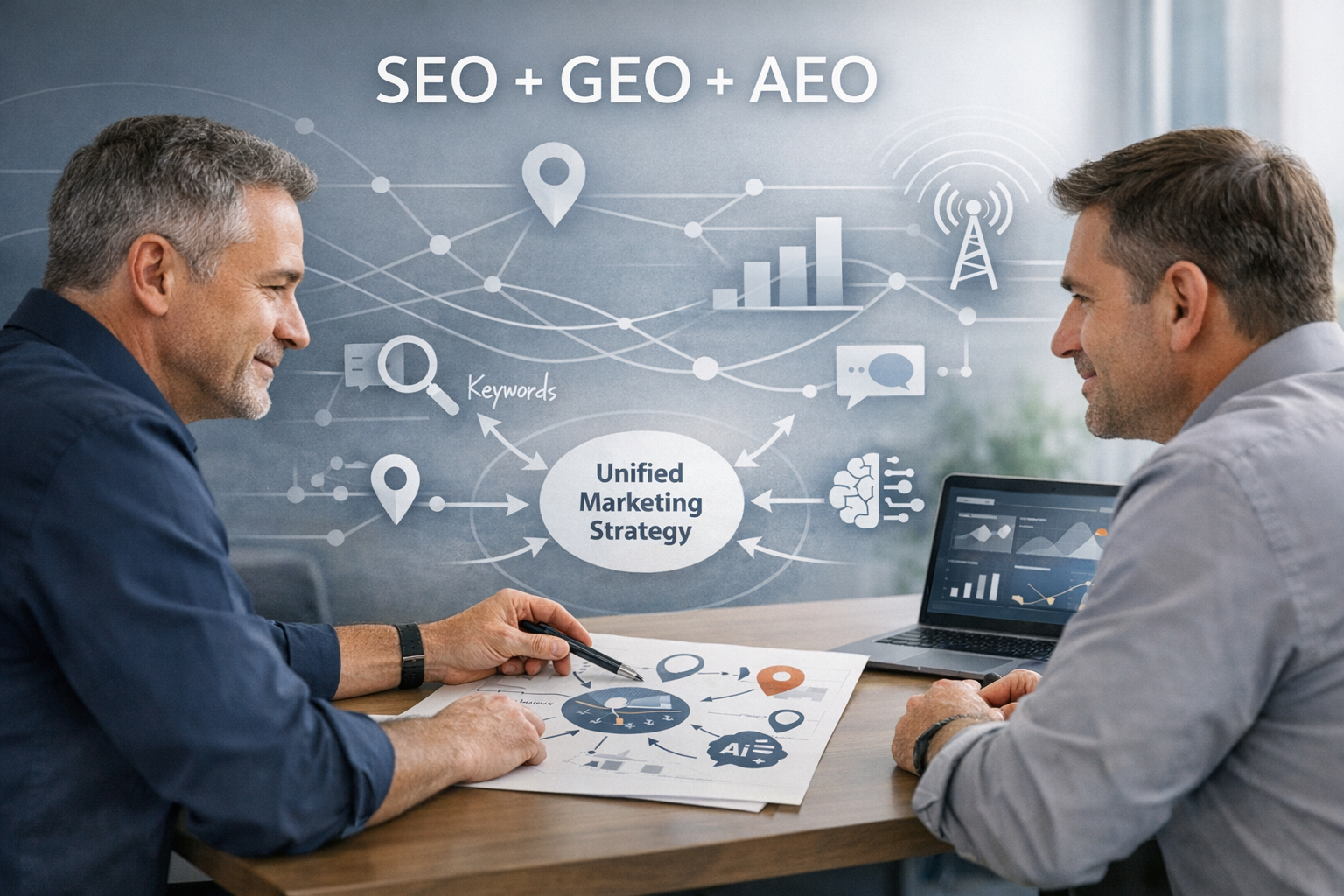
Most nationwide businesses run Google Ads in one silo, SEO in another, radio through a separate agency, and rarely think about their Google Business Profile listings or AI-search visibility at all. Each channel produces its own report. None of the reports talk to each other. And when someone asks whether the marketing budget is actually working, the honest answer is usually something like: we believe it is, but we have no way to show you the exact numbers.
That fragmentation is the single most common reason a search engine marketing budget underperforms. Not bad keywords. Not a low budget. Not weak creative. The channels are simply not connected.
A stronger approach treats Google Ads, SEO, Google Business Profile, GEO (Generative Engine Optimization), AEO (Answer Engine Optimization), and radio as one integrated system where the output of each channel feeds the others. This article explains what each channel is actually responsible for, how they connect, and how a nationwide business builds a strategy that works as a system rather than a collection of unrelated tactics.
Adwest has been building search engine marketing campaigns since 1997. Our team has worked with advertisers since Google’s earliest days, and across more than 25 years we have seen every version of the problem where a business is running a little of everything but none of it is coordinated. What follows is the framework we use to solve it.
A nationwide plumbing franchise runs Google Ads managed by one team, SEO managed by another, and a radio buy placed through a third vendor. Each team optimizes for its own metrics. The Google Ads team reports on cost per click. The SEO team reports on organic traffic. The radio agency reports on estimated reach. Nobody tracks what happens when a radio listener hears the brand name, searches it on Google, clicks a paid ad, and then converts.
This is not a hypothetical. It is the default setup for most multi-location businesses in the United States. And it creates real problems:
Integration does not mean one person manages everything. It means every channel operates with shared keyword intelligence, coordinated timing, and a common understanding of what each channel is responsible for in the customer journey.
The abbreviation GEO causes real confusion because it is used for two completely different things. Geographic targeting (sometimes called geo-targeting) means showing ads or content to people in specific locations. Generative Engine Optimization means structuring your content so AI-powered search systems can understand it, cite it, and surface it in AI-generated answers. These are not the same thing. Throughout this article, GEO refers to Generative Engine Optimization unless stated otherwise.
Before building an integration plan, every business owner needs to understand what job each channel performs. These channels are not interchangeable. They operate at different stages of the customer journey, they require different kinds of investment, and they produce results on different timelines.
| Channel | Primary Job | Customer Journey Stage | Key Metric | Speed to Results |
|---|---|---|---|---|
| Google Ads (PPC) | Capture high-intent search demand | Decision | Cost per acquisition, return on ad spend | Fast (days to weeks) |
| SEO | Build long-term organic visibility and authority | Research and decision | Organic traffic, rankings, conversions from organic | Slow (months) |
| Google Business Profile (GMB) | Win local searches and build trust at scale | Research and decision | Calls, direction requests, local pack visibility | Moderate (weeks to months) |
| GEO (Generative Engine Optimization) | Be cited by AI-search systems | Awareness and research | AI citations, referral traffic from AI sources | Emerging (variable) |
| AEO (Answer Engine Optimization) | Own featured answers and direct-answer positions | Research | Featured snippet appearances, People Also Ask inclusions | Moderate (weeks to months) |
| Radio | Generate branded demand and top-of-mind awareness | Awareness | Branded search lift, direct traffic, call volume during airtime | Moderate (weeks, depending on flight schedule) |
The most important column in that table is not the metric column. It is the customer journey stage column. Each channel operates at a different point in the path from having a problem to selecting a company to solve it. When you understand this, budget allocation becomes a strategic decision rather than a guess.
Google Ads is the fastest way to put your business in front of people who are actively searching for what you offer. For a nationwide business, the challenge is not whether to use Google Ads. It is how to structure campaigns so they perform across dozens or hundreds of markets with very different competition levels, search volumes, and costs per click.
The most effective Google Ads structure for a nationwide business organizes campaigns by the type of search intent, then layers geography on top. This is the opposite of what many businesses do, which is to create one campaign per city or region and throw all keyword types into it.
Intent tiers that typically matter most:
Geography then becomes a layer inside each intent tier. A brand campaign runs nationally. A high-intent service campaign might run in every market you serve but with different bids in different regions based on competition and cost per acquisition.
One of the most valuable things Google Ads produces is not clicks. It is data. Your search terms report shows you the exact phrases people use when they search for your services. That information should feed directly into your SEO content strategy. If your Google Ads data shows that hundreds of people each month are searching for pricing information on commercial HVAC maintenance, that is a content topic your SEO team should own with an in-depth page.
When Google Ads and SEO share keyword intelligence, both channels get stronger. The paid team stops spending on keywords the organic team already ranks for. The organic team focuses content on queries the paid data proves are real.
Google’s Performance Max campaigns use automated bidding and broad targeting across Google’s entire network. For nationwide businesses, Performance Max can help reach audiences across Search, Display, YouTube, and Maps simultaneously. But automated campaigns require careful oversight when you operate in markets with very different competition levels. A bid that makes sense in a low-cost rural market may be completely wrong in a high-cost metro area. Monitor geographic performance data regularly and set location-specific targets when possible.
SEO is the channel that builds long-term organic visibility. For a nationwide business, the goal is to rank for both national-level queries and local-level queries in every market you serve. This requires a clear content architecture, not just a collection of blog posts.
A hub-and-spoke model organizes your website’s content around central topic pages (hubs) that link to more specific supporting pages (spokes). For example:
This structure helps search engines understand the depth and breadth of your expertise. It also helps users navigate from a broad question to a specific answer without getting lost.
Nationwide businesses often need city or region-specific pages to rank in local searches. The problem is that many of these pages are created by swapping the city name in a template while keeping everything else identical. Google treats these as thin content, and they can hurt your site rather than help it.
A city page earns its place on your website when it includes:
If a city page does not have enough unique content to justify its existence, it is better to use a regional page that covers multiple nearby markets with genuine depth.
Google’s quality framework emphasizes Experience, Expertise, Authoritativeness, and Trustworthiness. For a nationwide business, this means your website should make it clear who is behind the content, what qualifies them to write about these topics, and what real-world experience informs the guidance. Author pages, company history, credentials, professional affiliations, and clear editorial standards all contribute to these signals.
Google Business Profile (still widely known as GMB) is where local search visibility lives. When someone searches for a plumber nearby or an air conditioning repair service in their city, the local map pack results come from Google Business Profile data. For a nationwide business, this channel requires deliberate management across every location or service area.
Google treats these differently, and your GBP strategy should reflect the distinction. A business with a physical storefront customers visit uses a standard GBP listing with a street address. A business that sends technicians to customer locations, such as a plumbing or HVAC company, uses a service-area business listing that shows the region served without displaying a home or office address.
Nationwide businesses that operate as service-area businesses in some markets and storefronts in others need both types of listings, managed correctly for each location.
NAP stands for Name, Address, and Phone number. Each Google Business Profile listing, each directory citation, and each place your business appears online must reflect identical name formatting, address details, and phone numbers. For a business with five locations, this is manageable. For a business with fifty or two hundred locations, inconsistencies accumulate fast and can suppress your local visibility.
Auditing NAP consistency at scale means checking every listing against a single master record and correcting variations, including abbreviations (St. vs. Street), suite number formatting, and phone number formats. This is not glamorous work, but it directly affects whether your locations appear in local search results.
Google Business Profile reviews affect local rankings, and they also appear to influence what AI-search systems reference when answering questions about service providers. A steady stream of authentic reviews builds trust signals for both traditional and AI-driven search. The most effective review strategies focus on asking satisfied customers at the moment of service completion, making the review process easy, and responding to every review, positive or negative, professionally.
Google Ads can use location extensions that pull directly from your Google Business Profile data. This means your paid ads can display your address, phone number, and proximity to the searcher. For a nationwide business, this connection only works well when every GBP listing is accurate, verified, and active. An outdated or unverified listing can prevent location extensions from appearing in exactly the markets where you need them most.
GEO (Generative Engine Optimization) is the practice of structuring your content and your online presence so that AI-powered search systems, such as Google’s AI Overviews, ChatGPT, and other large language models, can understand your business, trust your information, and cite you in AI-generated answers.
This is not the same as traditional SEO, though it builds on it. Traditional SEO focuses on ranking in a list of search results. GEO focuses on being included in an AI-generated answer, where the system synthesizes information from multiple sources and presents it directly to the user.
AI-search systems generally favor content that demonstrates:
No one can guarantee that any specific page will be cited by an AI system. These systems change frequently, and the selection process is not fully transparent. But content that meets the criteria above is more likely to be understood, considered, and referenced than content that is vague, thin, or structurally unclear.
GEO does not replace SEO. It extends it. A website with strong organic authority, well-organized content, and clear expertise signals is already in a better position for AI-search citation. Businesses that invest in SEO are simultaneously building the foundation that GEO requires. The GEO layer on top of that foundation is focused on making existing content more accessible for AI systems to process, pull from, and attribute.
AEO (Answer Engine Optimization) is the discipline of formatting your content so it can be selected for featured snippets, People Also Ask boxes, voice search responses, and AI Overviews that appear inside traditional search results. Where GEO is concerned with being referenced by generative AI platforms more broadly, AEO targets the direct-answer placements that appear prominently at the top of Google’s search pages.
The distinction matters for practical execution:
Both benefit from clear writing, logical structure, and direct answers. But AEO tends to reward precise formatting within individual pages, while GEO rewards broader site authority and content depth.
When you want a section of your page to be considered for a featured snippet or an AI-generated answer, use this pattern:
This pattern gives search engines a clean block to extract while giving human readers the detailed explanation they need.
FAQ schema markup tells search engines that a section of your page contains genuine questions and answers. Use it when your page actually includes a real FAQ section with questions your customers commonly ask and answers that are substantive and accurate. Do not add FAQ schema to content that is not structured as questions and answers. Misrepresenting content with schema markup can result in rich results being removed.
Radio might seem out of place in a search engine marketing strategy. It is not a search channel. You cannot bid on keywords, track clicks, or see a real-time dashboard. But radio does something that digital channels struggle to do on their own: it creates demand.
Digital search channels, especially Google Ads, are demand capture tools. They put your business in front of someone who is already searching. Radio is a demand generation tool. It reaches people who are not actively searching yet and plants your brand name in their memory so that when they do need your service, they search for you by name.
This is the mechanism: a business owner hears a radio ad for a commercial HVAC service provider during their morning commute. Three weeks later, their office air conditioning fails. They do not search for a generic AC repair option nearby. They search the brand name they remember from the radio ad. That branded search is easier to capture with Google Ads (lower cost, higher conversion rate) and may also result in an organic click or a direct website visit.
The most effective radio call to action for search marketing purposes is not a URL. It is a search instruction. Telling listeners to look up your brand name by name is far easier to remember and act on than reciting a web address. When you direct listeners to search your brand, you are feeding branded query volume into Google, which benefits both your paid and organic search performance.
If radio creates branded search demand, your Google Ads brand campaigns need to be running when that demand arrives. This means coordinating your radio flight schedule with your digital ad spend. When radio ads are on the air, branded search volume typically increases. If your brand campaign has been paused or underfunded during those periods, you lose the demand your radio investment created.
Radio attribution is not as precise as digital attribution, but it is not invisible either. Practical signals to monitor include:
None of these prove causation the way a click-through does, but together they build a reasonable picture of whether radio is generating the demand your digital channels are designed to capture.
Streaming audio and podcast advertising offer some of the same demand-generation benefits as traditional radio, often with better targeting options and, in some cases, trackable links or promo codes that improve attribution. For a nationwide business, the decision between terrestrial radio and digital audio depends on your audience, your markets, and your budget. Both can feed the branded search engine that Google Ads and SEO are built to capture.
Here is where the strategy becomes a system instead of a list. Each channel produces outputs that become inputs for other channels. When these connections are deliberate, the overall marketing investment compounds over time.
A single topic can power multiple channels simultaneously. For example, a comprehensive guide to commercial water heater maintenance could become:
Instead of creating six separate pieces of content for six channels, you create one substantive resource and distribute it strategically.
When your Google Ads team discovers that a phrase around replacing commercial boilers gets strong click-through and conversion rates, your SEO team should build a page targeting that exact topic. When your SEO data shows that a particular blog post drives high organic traffic but low conversion, your Google Ads team can test a remarketing campaign targeting those visitors. When your GBP listings generate questions about a specific service, your content team should address those questions on the website.
This feedback loop only works when the teams are communicating or when a single agency manages the full picture.
Branded search volume affects Google Ads quality scores, which in turn affects how much you pay per click and how often your ads appear. A strong radio campaign increases branded search volume, which can improve the efficiency of your Google Ads brand campaigns. At the same time, more people searching your brand name and clicking through to your website builds organic click-through rate and direct traffic signals that support SEO.
Consistent, positive reviews on your Google Business Profiles build trust signals that search engines and AI systems recognize. AI-search systems appear to consider review sentiment and volume when determining which businesses to reference in AI-generated answers about local services. Investing in review generation is not just a local SEO tactic. It is a GEO tactic.
This system does not produce overnight results. Google Ads can generate leads quickly. Organic search rankings require sustained effort before momentum builds. GBP reviews accumulate gradually. GEO visibility is still emerging and unpredictable. Radio creates demand that sometimes takes weeks to convert into a search. The compounding happens when all channels have been running long enough for their individual contributions to start reinforcing each other. Patience and consistent investment matter more than any single tactical adjustment.
The final piece of an integrated strategy is measuring it as a system rather than as six independent channels.
A cross-channel dashboard should be able to show you patterns like:
This level of visibility requires either a well-configured analytics setup or an agency partner that manages enough of the picture to connect the data. When you receive six separate reports from six separate vendors, seeing these patterns is nearly impossible.
Be cautious about vanity metrics that look impressive but do not connect to business outcomes. Total impressions, raw traffic numbers, and social media reach can all increase without generating a single customer inquiry. Focus on metrics that track what happens after someone finds you: calls, form submissions, booked appointments, and revenue, where trackable.
Most businesses cannot execute all six channels at full strength simultaneously. Budget, time, and staffing create real constraints. If you need to prioritize, consider this general order based on typical impact and speed to results:
This order is not rigid. The right sequence depends on your market size, competition, existing visibility, budget, and the kind of business you operate. A healthcare provider with strong local presence but no AI-search visibility may prioritize GEO earlier. A new HVAC company with no online presence may need Google Ads and GBP first before anything else makes sense.
Before investing in an integrated approach, a business owner should be able to answer, or ask their agency to answer, these questions:
If the answer to most of these is no or uncertain, that is not a failure. It is a starting point. Most businesses reach this stage because they grew into multiple channels over time without a plan to connect them.
GEO (Generative Engine Optimization) focuses on being cited and referenced by AI-powered search systems such as Google’s AI Overviews and ChatGPT. AEO (Answer Engine Optimization) is concerned with earning featured snippets, People Also Ask placements, and direct-answer positions inside traditional search results. Both require clear, well-structured content, but GEO emphasizes broader site authority and original value, while AEO emphasizes precise formatting and direct-answer structure on individual pages.
Yes, when possible. PPC provides immediate keyword performance data that should guide SEO content decisions. SEO builds long-term organic visibility that can reduce dependence on paid clicks over time. When managed by the same team or agency, the two channels share intelligence and avoid competing with each other for the same queries.
Google Business Profile controls your visibility in local map pack results, which appear for a large percentage of service-related searches. For businesses that serve customers at their location, such as plumbers, HVAC contractors, and healthcare providers, GBP is often the highest-impact local visibility channel. It also feeds trust signals that influence AI-search citations.
Radio generates awareness and plants your brand name in the listener’s memory. When that listener later needs your service, they are more likely to search your brand name on Google. That branded search is easier and less expensive to capture with Google Ads and improves organic click-through rates. Radio works best in a digital strategy when your search campaigns are already running and ready to capture the demand radio creates.
One verified listing per physical location or distinct service area. A business with fifteen office locations needs fifteen listings. A service-area business without a storefront may need one listing per distinct service region, depending on Google’s guidelines. The key is that each listing represents a real, distinct presence, not a duplicate created for ranking purposes.
A hub-and-spoke model organizes your website content around central pillar pages (hubs) that cover broad topics and link to more specific supporting pages (spokes) that address subtopics in detail. The structure helps search engines understand the depth of your expertise and helps users navigate from general questions to specific answers.
No. AI-search systems select which sources to cite based on complex and frequently changing criteria. No agency can guarantee placement in ChatGPT, Google’s AI Overviews, or any other AI-generated answer. What an agency can do is build the kind of content authority, technical accessibility, and structured clarity that make your business more likely to be considered and referenced.
If your search marketing channels are running in isolation, the path forward is not to add more channels. It is to connect the ones you have and build from there. The businesses that get the most from their marketing budget are the ones that treat Google Ads, SEO, Google Business Profile, GEO, AEO, and radio as one coordinated system rather than six separate expenses.
That coordination takes experience. It takes an understanding of how each channel works, what it contributes, and where the connections live. Adwest has been building these systems since 1997 with more than 25 years of search engine marketing experience across Google Ads PPC, SEO, GEO, AEO, Google Business Profile, GLSA, and radio.
If you want to understand how your current channels connect and where the gaps are, book a free consultation with Adwest’s digital marketing experts and get a free 14-day trial for GEO and AEO. Or call us directly at 800-350-5312. We will look at what you are running, what is working, and what a connected strategy could look like for your business.
