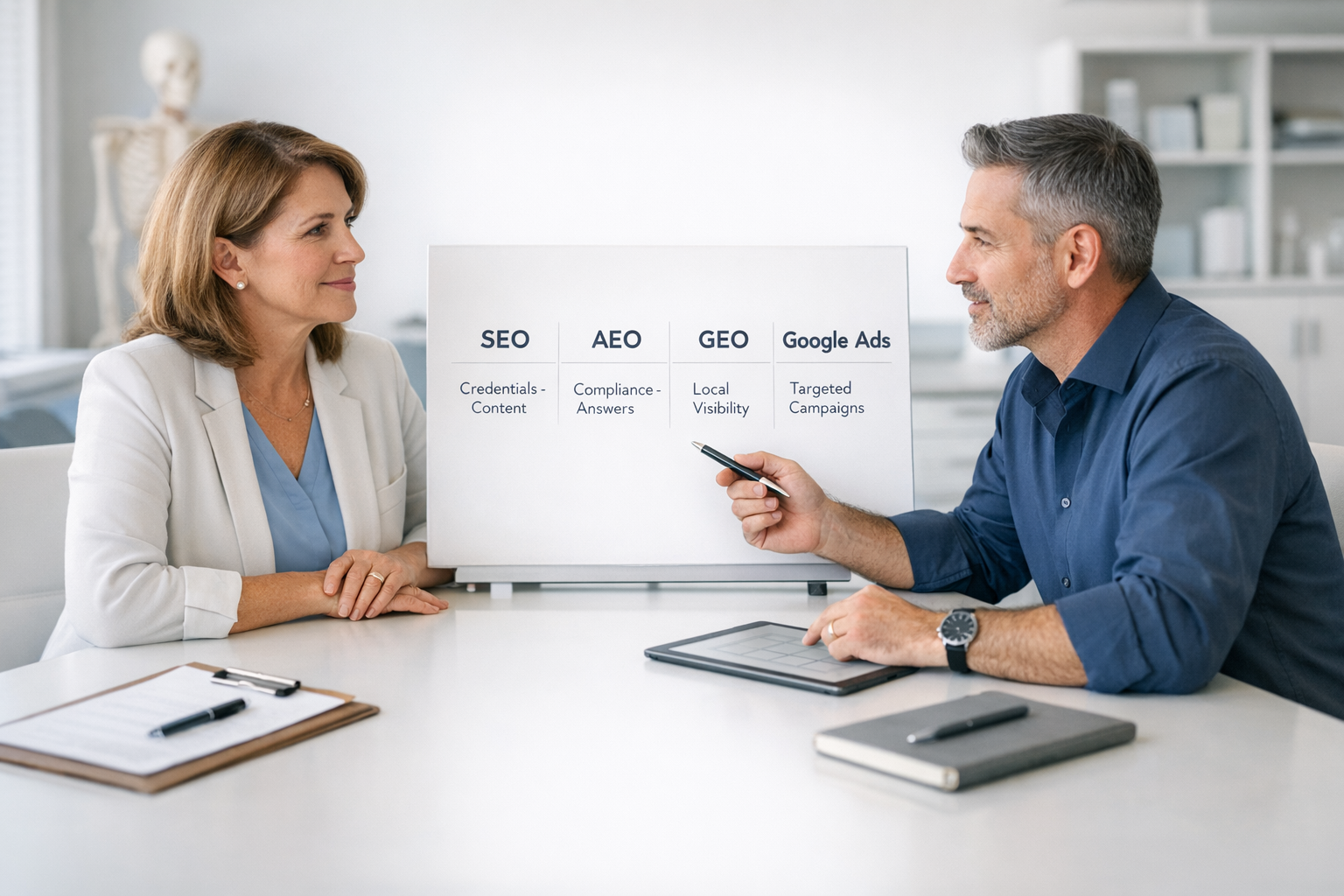
Healthcare providers can combine SEO, AEO, GEO, and Google Ads effectively by building every piece of content and every ad on the same evidence-first foundation — factual, credential-backed, outcome-honest information that satisfies both regulatory expectations and algorithmic preferences at the same time. The constraint that prevents healthcare organizations from making unsupported claims is not a barrier to search visibility. It is the very thing that makes search visibility sustainable, because what compliance demands and what search engines and AI systems reward point in exactly the same direction.
This guide explains how those four channels interact for healthcare providers specifically, what claim-safe language looks like in practice, and how to build a content and advertising workflow that creates qualified visibility without overpromising results.
Healthcare marketing is not the same as marketing a software tool or a home renovation service. Google classifies healthcare content under what it calls YMYL — Your Money or Your Life — which means pages that could affect a person’s health, safety, or financial wellbeing are held to a higher standard in search evaluation. That higher standard is built around E-E-A-T: Experience, Expertise, Authoritativeness, and Trustworthiness.
At the same time, healthcare advertising is subject to scrutiny from bodies like the FTC and FDA, and HIPAA governs how patient information can be handled in digital environments. These are not technicalities that can be ignored. They shape what a healthcare provider’s website, ad copy, and content strategy should look like.
Here is the insight that most healthcare marketing guidance misses: the things that keep a healthcare provider compliant are the same things that make content perform well in search.
When a healthcare provider eliminates unsupported claims from their digital marketing, they are not weakening their message. They are building the kind of content foundation that performs better across every channel — organic search, answer engines, AI-generated results, and paid search.
Section summary: Healthcare compliance and search performance are not in tension. They converge. The same evidence-first approach that satisfies regulatory standards also satisfies the algorithmic preferences of Google, AI search systems, and answer engines.
These four channels are not four separate strategies. They are four expressions of the same underlying content, each reaching patients at a different moment in their search journey. Understanding how they interact matters more than understanding each one in isolation.
| Channel | What It Does for Healthcare Providers | Where the Patient Encounters It | What It Requires from Content |
|---|---|---|---|
| SEO | Builds long-term organic visibility for condition, treatment, and provider searches | Google organic results, local pack, maps | Well-structured pages, credential signals, internal links, crawlable HTML |
| AEO | Positions content to appear as direct answers in featured snippets and voice search | Featured snippet boxes, People Also Ask, voice assistants | Direct-answer formatting, concise definitions, FAQ structure |
| GEO | Supports visibility in AI-generated search results like AI Overviews and ChatGPT answers | Google AI Overviews, ChatGPT search, other AI-mediated answers | Entity clarity, structured data, quotable explanations, crawlability for AI bots |
| Google Ads | Generates immediate visibility for high-intent patient searches | Paid positions in Google search results, GLSA placements | Claim-safe ad copy, compliant landing pages, proper tracking configuration |
All four channels reward the same core behavior: clear, specific, trustworthy content that answers real patient questions without overstating what any treatment or provider can guarantee. A single well-built page — structured with direct answers, backed by identifiable expertise, honest about outcomes, and formatted for easy extraction — can serve SEO, AEO, and GEO simultaneously. That same page becomes the landing destination for Google Ads, closing the loop.
The mistake most healthcare providers make is treating these as four separate projects with four separate teams and four separate content standards. When they are built on the same evidence-first foundation, they reinforce each other instead of competing for resources.
Section summary: SEO, AEO, GEO, and Google Ads each reach patients at different moments, but all four perform best when built on the same clear, evidence-first content.
Evidence-first content means every claim on a healthcare provider’s website, every ad headline, and every FAQ answer starts with what can be supported — not with what sounds most persuasive. This is a practical content standard, not a vague principle.
The difference between claim-safe healthcare content and problematic healthcare content is usually specific and identifiable. Here are examples of how the same information can be communicated differently:
| Problematic Language | Claim-Safe Alternative | Why It Matters |
|---|---|---|
| Promising patients a complete recovery. | Recovery timelines differ from one patient to the next. Our clinical team works alongside you to pursue the strongest possible outcome for your situation. | Guaranteeing outcomes in healthcare advertising is a compliance risk and an ad policy violation. |
| Claiming to be the top orthopedic surgeon anywhere in the state. | A board-certified orthopedic surgeon bringing 15 years of focused experience in joint replacement procedures. | Unsupported superlatives are restricted in healthcare ads and weaken trust signals for search systems. |
| Stating that patients leave permanently free of chronic pain. | Our pain management approach is structured to help reduce symptoms and restore daily function over time. | Cure claims for chronic conditions create regulatory risk and reduce content credibility. |
| Advertising a miracle solution that wipes out diabetes entirely. | Clinically grounded diabetes management programs designed to support improved blood sugar control. | Miracle claims violate FTC standards and are flagged by Google Ads review. |
| Advertising a perfect success record across all patients. | Our clinical team applies evidence-based protocols at every stage to support the strongest achievable patient outcomes. | Specific success rate claims require verifiable data and can mislead patients. |
Notice the pattern. The claim-safe alternatives are not weaker. They are more specific, more credible, and more useful to a patient trying to make a decision. They also happen to be exactly the kind of language that search engines and AI systems treat as trustworthy.
For healthcare content to satisfy E-E-A-T standards and support YMYL evaluation, the page should make it clear who created or reviewed the information. This means:
These are not just trust signals for Google. They are practical credibility markers for patients who are evaluating whether to call, book, or keep searching.
Structured data helps search engines and AI systems understand what a page is about and who stands behind it. For healthcare providers, the most relevant schema types include:
Schema should accurately describe the page. It should never be used to imply credentials, services, or affiliations that do not exist. Misrepresenting structured data is a policy violation and undermines the trust signals it is supposed to create.
One underused strategy in healthcare content is including a clear section on when a patient should seek professional medical attention. This serves two purposes:
This is a practical content decision, not a trick. It makes the page more useful and more trustworthy at the same time.
Section summary: Evidence-first content replaces vague superlatives with specific, credential-backed statements. It includes author identification, appropriate schema markup, and safety-conscious guidance — all of which improve both compliance and search performance.
A well-structured healthcare page does not need three different versions for three different channels. It needs one clear structure that all three systems can work with.
When a patient searches for a condition, treatment, or provider-related question, answer engines look for a concise, direct response near the top of the page. For healthcare content, this means:
This format serves AEO by making the page easy to extract for featured snippets. It also serves the patient, who gets their answer without scrolling through introductory filler.
AI-generated search results — including Google’s AI Overviews and responses from systems like ChatGPT — tend to draw from pages where the entities, relationships, and facts are stated clearly and consistently. For a healthcare provider, this means:
None of the above works if the page cannot be crawled, indexed, and understood by search systems. The technical foundation still matters:
If you want the page to be eligible for AI-search surfaces like ChatGPT search results, your site should also allow the relevant crawlers in your robots.txt configuration. For example, OpenAI’s OAI-SearchBot must be permitted for a page to appear in ChatGPT search answers.
Section summary: One well-structured page — answer-first, entity-clear, crawlable, and internally linked — can serve SEO, AEO, and GEO simultaneously without requiring separate versions for each channel.
Google Ads for healthcare operates under a stricter set of policies than most other categories. Healthcare providers can run effective paid search campaigns, but the ad copy, landing pages, and tracking configuration all need to reflect the compliance reality of the industry.
Google’s advertising policies for healthcare include restrictions on:
These restrictions are not arbitrary. They exist to protect patients, and they align with the same evidence-first standard that makes organic content perform well.
| Problematic Ad Copy | Claim-Safe Ad Copy |
|---|---|
| Top-rated knee surgeon — outcomes guaranteed | Board-certified knee surgeon — book your consultation today |
| Eliminate your back pain permanently | Evidence-based back pain treatment — request an appointment |
| Voted the number one dental office in the area | Experienced dental team now welcoming new patients |
| Drop 30 pounds in just 30 days | Physician-supervised weight management programs available |
| Revolutionary cure for allergies | Full-spectrum allergy evaluation and personalized treatment plans |
The claim-safe versions are not less compelling. They communicate the same value — expertise, availability, treatment focus — without triggering ad disapprovals or misleading patients.
A compliant ad that sends a patient to a non-compliant landing page creates two problems. First, Google’s ad review evaluates the landing page alongside the ad copy, so misalignment can result in disapprovals. Second, a patient who clicks an honest ad and arrives at a page full of outcome guarantees will experience a credibility disconnect that damages trust.
The ad and the landing page should use the same tone, the same level of claim restraint, and the same evidence-first standard. This is where the single content foundation pays off — when the page was built to be evidence-first from the start, it already works as a compliant landing page.
Healthcare providers running Google Ads should be aware that digital advertising tracking tools can intersect with patient data in ways that have HIPAA implications. How tracking is configured across a healthcare website is a compliance consideration that goes beyond marketing decisions alone.
This is not legal advice. Healthcare providers should work with qualified compliance counsel to evaluate their specific tracking configuration and ensure all applicable HIPAA requirements are met in their digital advertising setup.
Section summary: Google Ads for healthcare can generate strong visibility when the ad copy, landing pages, and tracking configuration all follow the same evidence-first standard. Claim-safe ad copy performs better with Google’s review systems and builds more patient trust.
Having an evidence-first standard only works if there is a practical process to enforce it before content and ads go live. Most healthcare providers understand the principle but lack an operational workflow.
Before publishing any healthcare content or activating any ad campaign, confirm the following:
This checklist is not exhaustive, and healthcare providers should adapt it based on their specialty, regulatory environment, and the advice of qualified compliance professionals. But it provides a starting point that prevents the most common mistakes.
The safest and most useful keyword strategy for healthcare providers starts with first-party data — the questions patients actually ask, the searches that already bring traffic to the site (visible in Google Search Console), and the queries that drive paid search conversions. Building content around real patient language is more effective and more compliant than chasing high-volume keywords that may push toward overstated claims.
Section summary: A practical review workflow with clinical, marketing, and compliance checkpoints prevents unsupported claims from reaching patients. A clear checklist keeps the team aligned before anything goes live.
Combining SEO, AEO, GEO, and Google Ads creates more visibility opportunities, but it also creates more ways to misread performance data. Healthcare providers and their agencies need a measurement approach that is honest about what each channel can and cannot tell you.
As AI-generated search answers become more common, some traffic that previously came through traditional organic clicks may now arrive through AI-mediated referrals. Monitoring this separately — when the tools allow it — helps healthcare providers understand whether their content is being cited in these newer surfaces. It also helps avoid conflating organic traffic declines with actual visibility losses when traffic is simply shifting between channels.
Results from any digital advertising or search marketing strategy vary based on market size, competition, budget, offer quality, website conversion rate, tracking quality, and campaign execution. Healthcare providers should expect their agency to report clearly on what is working, what is not, and what the data actually supports — not to present inflated metrics or guaranteed projections.
A strong agency relationship is built on reporting clarity, not on promising specific outcomes.
Section summary: Each channel has its own performance indicators. Measuring them separately, monitoring AI referral traffic, and insisting on honest reporting creates a clearer picture of what the combined strategy is actually achieving.
To make this practical, here is how SEO, AEO, GEO, and Google Ads could work together for an orthopedic practice offering knee replacement consultations.
SEO: The practice publishes a comprehensive page covering what patients can anticipate from knee replacement surgery — written with a direct-answer opening, authored by a board-certified orthopedic surgeon, with structured data identifying the practice and provider. The page links internally to the practice’s provider profiles, appointment booking page, and related condition pages.
AEO: The same page includes a FAQ section addressing questions such as how long recovery typically takes after knee replacement and how patients can determine whether they are a suitable candidate — each followed immediately by a concise, factual response. These are formatted so answer engines can extract them for featured snippets and voice search responses.
GEO: The page uses consistent terminology throughout, includes a section advising patients to consult a provider if they experience persistent knee pain that limits daily activities, and states facts in clear, quotable sentences. The site allows relevant AI crawlers. These structural choices support the page’s eligibility for AI-generated search answers.
Google Ads: The practice runs a search ad identifying the surgeon’s board certification and inviting prospective patients to schedule a consultation. The ad links to the same evidence-first page, which serves as a compliant landing page. No outcome guarantees appear in the ad or on the page. Tracking configuration is reviewed with qualified compliance counsel to ensure patient information is handled appropriately.
All four channels draw from the same content foundation. The compliance standard is consistent across every touchpoint. The patient experience is coherent from search to page to appointment request.
Section summary: A single evidence-first page, built once and built well, can serve as the foundation for organic rankings, answer engine placement, AI-search citation, and paid search landing — all without making a claim the practice cannot support.
If a healthcare provider is working with a digital advertising agency — or considering one — the agency should be able to demonstrate a clear approach to claim-safe content, multi-channel integration, and honest performance reporting.
Questions worth asking:
At Adwest, we have been providing digital marketing campaigns since 1997, and our team of search engine marketing professionals has worked with advertisers since Google’s earliest days — more than 25 years of experience across Google Ads PPC, SEO, GEO, and AEO. We understand that healthcare providers face a different set of constraints than other industries, and we approach those constraints as strategic advantages rather than obstacles.
We do not guarantee specific rankings, lead volumes, or ROI figures, because results depend on market size, competition, budget, offer quality, website conversion rate, tracking quality, and campaign execution. What we do provide is experienced, accountable search engine marketing support that helps healthcare providers build qualified visibility across the channels that matter — including the AI-search surfaces that are becoming increasingly important.
SEO focuses on building organic search visibility through well-structured, authoritative content. AEO focuses on positioning that content to appear as direct answers in featured snippets and voice search. GEO focuses on making content eligible for citation in AI-generated search results like Google AI Overviews and ChatGPT. For healthcare providers, all three depend on the same evidence-first content standard.
Yes. Healthcare providers can run Google Ads campaigns effectively by using claim-safe language, avoiding outcome guarantees and unsupported superlatives, and ensuring that landing pages align with the ad copy in tone and claims. Some healthcare categories require additional certification through Google. Providers should also consult qualified compliance counsel for their specific regulatory situation.
Healthcare ads should generally avoid unsupported superlatives like “best,” “top,” or “#1” without verifiable third-party backing, language that implies guaranteed or perfect outcomes, cure claims for chronic conditions, and terms like “miracle” or “revolutionary” that cannot be substantiated. Claim-safe alternatives focus on credentials, experience, evidence-based approaches, and availability.
Focus on the same fundamentals that support traditional search: clear, accurate content backed by identifiable expertise, structured data that accurately represents your practice and providers, answer-first formatting, consistent terminology, and technical crawlability. Allow relevant AI crawlers in your robots.txt configuration. There is no special trick — the same evidence-first approach that works for SEO also supports AI-search visibility.
It can. Digital advertising tracking tools can intersect with patient data in ways that have HIPAA implications, and how tracking is configured across a healthcare website is a compliance consideration that goes beyond marketing decisions alone. Healthcare providers should consult qualified compliance counsel to ensure their tracking setup meets all applicable requirements.
For content that makes statements about conditions, treatments, procedures, or clinical outcomes, having a qualified medical professional review the content before publication strengthens both compliance and E-E-A-T signals. It also reduces the risk of publishing inaccurate health information that could harm patients or create regulatory exposure.
Patient testimonials can be used, but they should include appropriate disclosures, should not imply that described outcomes are typical or guaranteed, and must comply with HIPAA regarding patient identity and authorization. Healthcare providers should consult qualified compliance professionals for guidance specific to their practice and state regulations.
They work together when built on the same evidence-first content foundation. SEO builds long-term organic visibility. AEO positions content for direct-answer extraction. GEO supports citation in AI-generated results. Google Ads drives immediate paid visibility. The landing page for paid ads can be the same well-structured page that serves organic, answer, and AI-search channels — creating a unified, compliant strategy rather than four separate efforts.
If you are a healthcare provider evaluating how to build a digital marketing strategy that covers organic search, answer engines, AI search visibility, and paid search without putting your practice at risk from unsupported claims, the path forward starts with understanding where your current content and advertising stand relative to evidence-first standards.
Adwest helps healthcare providers across the United States build search engine marketing strategies that are practical, accountable, and built for the way patients search today — including the AI-search surfaces that are reshaping how healthcare information is discovered. With more than 25 years of experience across Google Ads PPC, SEO, GEO, and AEO, our team understands the difference between aggressive marketing and effective marketing in a regulated industry.
Book a Free Consultation with Adwest’s Digital Marketing Experts and get a Free 14 Day Trial for GEO and AEO. Or call us directly at 800-350-5312.
