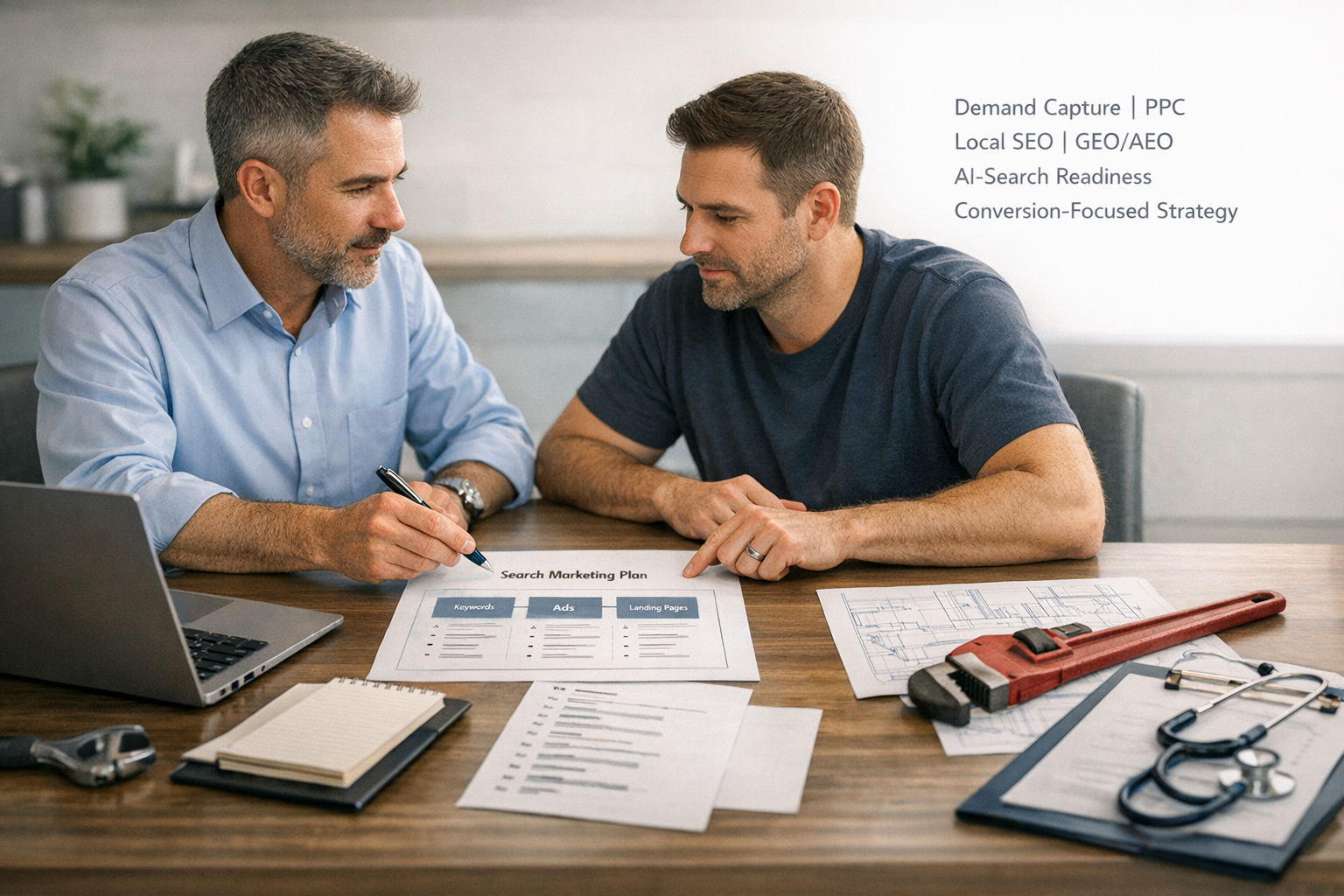
For businesses whose customers need help now — a burst pipe, a failed air conditioner, or an urgent medical concern — the most effective marketing channels are the ones that capture existing demand rather than try to create new awareness. The priority order for most service businesses and healthcare providers is Google Search Ads (PPC), Google Local Services Ads, Local SEO with a strong Google Business Profile, and a growing layer of AI-search visibility through GEO and AEO. The rest of this article explains why each channel works for urgent buyers, what each one requires to actually convert, and how to think about channel mix when your budget has limits.
This matters because urgent customers behave differently than casual browsers. They are not scrolling social media looking for inspiration. They are typing a specific problem into a search bar — or asking an AI assistant — and choosing from the first options that look trustworthy and reachable. If your business is not visible at that exact moment, someone else gets the call.
Not all marketing channels do the same job. Some channels capture demand — they intercept people who are already searching for a solution. Other channels create demand — they build awareness among people who may need your service in the future but are not looking for it right now.
For a plumbing company, an HVAC contractor, or a healthcare provider whose patients often arrive with pressing needs, the distinction is critical. A social media ad might remind someone that your business exists, but it does not reach the homeowner standing in a flooded basement at 10 p.m. searching for “emergency plumber near me.” That homeowner is already in motion. The channel that reaches them needs to be where they are looking — not where you wish they were looking.
Demand capture channels include paid search ads, Local Services Ads, local SEO listings, and AI-search visibility for direct-answer queries. Demand creation channels include social media advertising, display ads, radio, and brand awareness campaigns. Both types matter, but if your customers make decisions under time pressure, demand capture should come first.
A high-intent customer is someone who has moved past browsing and is actively trying to solve a problem, make a decision, or take action. In search terms, this is the difference between someone searching “best HVAC brands” (researching) and someone searching “AC repair today near me” (ready to hire).
High-intent searches tend to include words like “near me,” “today,” “emergency,” “cost,” “appointment,” “available now,” or a specific service name combined with a location. These queries represent real buying behavior, and the channels that intercept them consistently outperform channels that rely on interruption or passive exposure — at least for the immediate conversion.
Awareness channels like social media, display advertising, and even radio have real value. They build brand recognition, support long-term recall, and can influence which company a customer thinks of when the need arises. But for the moment of urgent need itself, they are not where the customer goes. A person with a leaking roof does not open Instagram to find a roofer. They search.
This does not mean awareness channels are worthless — it means they play a supporting role for businesses with urgent customers, not the primary role. The primary role belongs to the channels that are present at the moment of need.
| Channel | Intent Level | Speed to Results | Best For |
|---|---|---|---|
| Google Search Ads (PPC) | Very High | Immediate once live | Capturing active search demand for specific services |
| Google Local Services Ads | Very High | Immediate once approved | Service businesses in eligible categories; high-trust placement |
| Local SEO / Google Business Profile | High | Weeks to months to build | Local visibility in Map Pack and near-me searches |
| Organic SEO | High | Months to build, durable over time | Long-term search visibility for informational and service queries |
| GEO / AEO (AI-Search Visibility) | High | Varies; emerging channel | Appearing in AI-generated answers and LLM-driven search |
| Online Reviews | Supports conversion | Ongoing | Building trust at the decision point; influencing which business gets chosen |
| Retargeting | Moderate | Days after initial visit | Re-engaging visitors who did not convert on first contact |
| Social Media Ads | Low to Moderate | Varies | Seasonal awareness, brand building, retargeting support |
| Radio | Low (awareness) | Weeks to months | Brand recall, market presence, top-of-mind positioning |
Google Search Ads — also called Google Ads PPC or Google AdWords — are the most direct channel for reaching customers with urgent, high-intent needs. When someone searches “emergency plumber near me” or “urgent care open now,” a well-structured paid search ad can appear at the top of results within seconds of the search happening.
What makes paid search effective for urgent intent is not just placement — it is the ability to match your ad to the specific problem the customer is trying to solve, at the exact moment they are trying to solve it. This requires more than setting up an account and running ads. It requires:
PPC is not a set-it-and-forget-it channel. Campaign performance depends on bid strategy, keyword refinement, negative keyword management, quality score, and continuous monitoring. But for businesses that serve urgent customers, it is typically the fastest way to put your business in front of someone who is ready to hire — and it is measurable in a way that many other channels are not.
At Adwest, search engine marketing professionals have managed Google Ads PPC campaigns since Google’s early days. With more than 25 years of digital marketing experience, our team understands how to structure campaigns around buyer intent rather than just keyword volume — which is the difference between paying for clicks and paying for opportunities.
Google Local Services Ads (GLSAs) are a distinct ad format that appears above standard paid search ads for eligible service categories. They look different from regular Google Ads — they display the business name, review rating, hours, and a Google Guaranteed or Google Screened badge, depending on the category.
For urgent customers, this format carries significant trust signals. The Google badge tells the searcher that Google has verified the business to some degree, which can reduce the hesitation that comes with hiring a company you have never used before — especially under pressure.
Key differences between GLSAs and standard Google Ads:
For plumbers, HVAC contractors, and other service businesses in eligible categories, GLSAs can be one of the highest-converting ad formats available — because they combine top placement with trust signals at the exact moment an urgent customer is searching. Eligibility and performance vary by market, category, and competition, but for businesses that qualify, this channel is worth serious consideration.
Before a customer ever sees a paid ad, they may see the Google Map Pack — the block of local business listings that appears for location-based searches. This Map Pack is powered primarily by Google Business Profile (formerly Google My Business) data, and for many urgent searches — “plumber near me,” “walk-in clinic open now,” “AC repair [city name]” — it is the first thing a customer sees.
A well-maintained Google Business Profile affects whether high-intent customers find your business at all. Key factors include:
Local SEO is not as fast as turning on a paid search campaign. Building visibility in the Map Pack takes consistent effort over weeks and months. But once established, local SEO provides a layer of visibility that does not depend on ad spend — and for many service businesses, the Map Pack generates a significant share of inbound calls.
For urgent customers, reviews play a specific and powerful role. When someone needs a plumber right now or needs to choose an urgent care clinic they have never visited, they do not have time for extended research. They look at the star rating, scan a few recent reviews, and make a fast judgment about trustworthiness.
This means reviews function as a conversion mechanism — not just a visibility signal. A business with a strong review profile does not just appear more often in search results; it gets chosen more often once it appears.
What matters most for urgent buyers:
Review management is not a separate marketing channel in the traditional sense, but it directly affects whether every other channel actually converts. A strong PPC ad that sends a customer to a business with a 3.2-star rating and no recent reviews is unlikely to produce a call.
Organic search engine optimization is the process of improving your website’s visibility in unpaid search results. For businesses with urgent customers, organic SEO is not the fastest channel — it takes time to build rankings, and the results compound over months rather than appearing overnight.
But organic SEO supports high-intent capture in an important way. When your website ranks well for terms like “what to do when your AC stops working” or “signs you need emergency plumbing,” you are reaching people at or near the moment of need — without paying per click. Over time, strong organic content can reduce dependence on paid channels and create a more sustainable flow of inbound inquiries.
SEO works best alongside paid search, not instead of it. PPC captures immediate demand while organic rankings build. As organic visibility strengthens, the two channels reinforce each other — paid ads provide data on which keywords convert, and organic content provides broader coverage across related queries.
An increasing number of people are asking questions through AI tools — ChatGPT, Google’s AI Overviews, Perplexity, and other large language model (LLM) powered search experiences. When someone asks an AI assistant “who should I call for emergency HVAC repair,” the answer the AI provides is drawn from the content it can access, understand, and trust.
Generative Engine Optimization (GEO) is the practice of structuring and positioning your content so that generative AI search engines can find, understand, and surface it in their responses.
Answer Engine Optimization (AEO) is the practice of formatting your content so that AI systems can extract clear, direct answers from it — making your business more likely to appear when an AI tool responds to a relevant query.
These are emerging disciplines, and it is important to be honest about what they can and cannot do today. AI-search visibility is not the same as ranking on Google. Placement in AI-generated responses is not guaranteed by any technique, and the landscape is still evolving. But for businesses that want to be visible where customers are increasingly looking, GEO and AEO represent a meaningful and growing opportunity.
What helps with AI-search visibility includes having clear, well-structured website content, accurate business information across the web, strong topical authority in your service areas, and content that directly answers the kinds of questions customers ask. These are practices that also support traditional SEO — which is part of what makes GEO and AEO a natural extension of a strong search strategy rather than a completely separate effort.
Adwest has been providing digital marketing campaigns since 1997, and our team has been tracking and adapting to changes in search since Google’s earliest days. GEO and AEO represent the next layer of search visibility, and we approach them with the same practical, results-oriented mindset we bring to every channel — honest about what varies, focused on what works.
Not every urgent customer converts on the first visit. Some get distracted, some compare options, some call but get sent to voicemail and move on. Retargeting allows you to show follow-up ads to people who visited your website or interacted with your business but did not complete a conversion.
For urgent-intent businesses, retargeting is a secondary channel — it will not generate the first contact, but it can recover opportunities that would otherwise be lost. It works best when paired with a strong primary demand-capture channel like PPC.
Social media ads are effective at building brand awareness, promoting seasonal offers, and reaching people who are not actively searching. For urgent customers, however, social media is rarely the channel where the decision happens. A homeowner with a broken furnace in January is not scrolling Facebook to find an HVAC technician — they are searching.
Social media can support urgent-intent businesses in specific ways: seasonal demand generation (reminding homeowners to schedule AC maintenance before summer), retargeting website visitors, and community-level brand building. But as a primary acquisition channel for urgent customers, it typically underperforms search-based channels.
Radio advertising builds brand recognition over time. For service businesses, radio can make your company the first name a customer thinks of when the need arises. It does not capture urgent demand in real time, but it can influence which business a customer searches for when the moment comes.
Radio works best as a complement to search-based channels — creating the name recognition that makes a customer more likely to click on your ad or choose your listing over an unfamiliar competitor.
Email and SMS are valuable for staying in touch with past customers, sending appointment reminders, and promoting maintenance plans. For urgent, first-time customer acquisition, they are not primary channels. Their strength is in turning one-time urgent customers into repeat clients — which is where long-term business value often lives.
Choosing the right marketing channels is only half the equation. The other half is what happens when an urgent customer actually reaches your business. If the marketing works but the conversion experience fails, the investment is wasted.
Speed-to-lead is the time between a customer’s first contact attempt and your business’s first response. For urgent customers, this window is extremely short. A homeowner with a burst pipe is not going to leave a voicemail and wait patiently for a callback tomorrow. They will call the next business on the list.
Fast response is not just good customer service — it is the mechanism that converts marketing spend into actual revenue. Every channel in your marketing mix becomes more effective when the business behind it responds quickly.
When an urgent customer calls and no one answers, the cost is not just one lost job. It is the full cost of the ad click or the marketing effort that generated that call, plus the revenue the job would have produced, plus the potential lifetime value of that customer. The exact dollar amount varies by business and market, but the pattern is consistent: missed calls from high-intent customers are among the most expensive wastes in service business marketing.
A website receiving traffic from high-intent search channels needs to make it immediately easy for the visitor to take action. That means:
The landing page is where marketing investment either converts or leaks. No amount of PPC budget or SEO effort compensates for a website that makes it hard to call, hard to find the right service, or hard to trust the business.
Conversion friction is anything that makes it harder for a customer to take the next step. For urgent customers, even small friction points — a form with twelve fields, a phone number buried in the footer, a “request a quote” process that takes three business days — can cause the customer to leave and contact a competitor instead.
The goal is to make contacting your business as easy as the customer’s need is urgent. Click-to-call buttons, short forms, and clearly visible phone numbers are minimum requirements, not premium features.
One of the most common challenges for business owners running multiple marketing channels is knowing which one actually generated the lead. Without proper tracking, a PPC campaign might appear to underperform while actually driving most of the phone calls — or a social media campaign might look productive based on impressions but generate almost no real inquiries.
Attribution does not need to be complicated, but it does need to exist. At a minimum, a service business should be able to answer: “Which channel generated this call or form submission?”
Call tracking works by assigning a distinct phone number to each marketing source, making it possible to trace every inbound call back to the specific ad, listing, or page that produced it. Form tracking records which page and which traffic source led to each form submission. Together, these tools provide the basic data needed to evaluate channel performance honestly.
Without call tracking and form tracking, businesses are often making budget decisions based on incomplete information — which can lead to cutting channels that are working or continuing to fund channels that are not.
Clicks tell you how many people visited your website. Impressions tell you how many times your ad or listing appeared. Neither tells you how many people actually called, booked, or became a customer. For businesses serving urgent customers, the metrics that matter are calls, form submissions, booked jobs, and revenue generated — not traffic volume.
This is one of the most important things to discuss with any agency managing your marketing. Clear, honest reporting tied to real business outcomes — not vanity metrics — is what allows you to make better decisions about where to invest.
If your budget is limited — and most budgets are — the most effective starting point is the channel that captures demand from customers who are already searching. For most service businesses and healthcare providers serving urgent needs, that means starting with Google Ads PPC and ensuring your Google Business Profile is accurate and well-maintained.
Once the demand-capture foundation is working and measurable, additional channels can be layered in: organic SEO to build durable visibility, GEO and AEO to extend reach into AI-driven search, GLSAs if your business category is eligible, and awareness channels like radio or social media to support long-term brand recognition.
The logic is straightforward: capture the customers who are already looking for you before spending to reach people who are not looking yet.
Adding a new channel makes sense when your current channels are performing well but reaching a ceiling — you are showing up for the searches that matter, converting at a reasonable rate, and want to grow beyond what current demand capture can deliver.
Going deeper on an existing channel makes sense when performance data shows room for improvement — better keyword targeting, stronger landing pages, improved ad copy, faster response times, or better tracking. Often, refining what you already have produces a better return than spreading budget across an additional channel that is not yet set up to succeed.
The right next step depends on your goals, budget, market, competition, and current visibility. There is no universal formula, which is why honest assessment of your specific situation matters more than following a generic playbook.
Demand capture channels reach people who are already searching for a solution — like Google Search Ads and Local SEO. Demand creation channels build awareness among people who are not currently looking — like social media ads, display ads, and radio. For businesses with urgent customers, demand capture typically delivers faster, more measurable results.
Google Search Ads appear at the moment someone is actively searching for a specific service. Social media ads appear while someone is browsing content unrelated to their immediate needs. Urgent customers act through search, not social feeds, which is why search ads tend to outperform social ads for immediate, high-intent demand.
A Google Local Services Ad (GLSA) appears above standard Google Ads in search results and includes a Google Guaranteed or Google Screened badge. GLSAs typically charge per lead rather than per click, and they require a verification process. They carry stronger trust signals than standard ads, which can improve conversion rates for service businesses in eligible categories.
If you need to reach urgent customers quickly, Google Ads PPC provides the fastest path to visibility. SEO takes longer to build but creates durable organic visibility over time. For most businesses, starting with PPC while building SEO produces the best combination of short-term results and long-term sustainability. The two channels complement each other.
Generative Engine Optimization (GEO) focuses on making your content visible in AI-powered search tools like ChatGPT and Google’s AI Overviews. Traditional SEO focuses on ranking in standard search engine results. GEO involves structuring content so AI systems can understand, extract, and surface it in generated responses. Many GEO best practices overlap with strong SEO, but GEO also involves considerations specific to how language models process and cite information.
As fast as possible. Urgent customers are often contacting multiple businesses simultaneously. The first business to respond with a clear, helpful answer is significantly more likely to earn the job. Every minute of delay increases the chance that the customer has already committed to a competitor.
Call tracking and form tracking are the most practical tools. With call tracking, each marketing source receives its own dedicated number so every inbound call can be traced to the channel that produced it. Form tracking records which traffic source led to each submission. Without these tools, channel performance assessment is largely guesswork.
AI-search visibility is an emerging opportunity. More people are using AI tools to find service providers, and businesses that appear in AI-generated responses gain exposure to those users. Results vary, and this channel is still maturing. But the trend toward AI-assisted search is real, and businesses that start building visibility now may have an advantage as adoption grows.
The best marketing channel for your business depends on how your customers behave when they need you. If your customers search with urgency — and if your business depends on being found at that moment — then the channels that capture active search demand should be the foundation of your marketing investment. Google Ads PPC, Google Local Services Ads, Local SEO, and a growing layer of AI-search visibility through GEO and AEO represent the strongest combination for reaching high-intent buyers who cannot wait.
But channel selection is only the beginning. Campaign structure, landing page quality, response speed, tracking, and honest performance reporting all affect whether your marketing spend translates into actual business results. And because results vary by market size, competition, budget, offer quality, website conversion rate, and execution, the right approach is one built around your specific situation — not a one-size-fits-all template.
Adwest has been providing digital marketing campaigns since 1997. Our search engine marketing professionals have worked with advertisers since Google’s inception, with more than 25 years of experience in PPC, SEO, GEO, and AEO. We understand what urgent-customer businesses need because we have been building and managing these campaigns for decades — across plumbing, HVAC, healthcare, and service businesses nationwide.
If you want to understand which channels make sense for your business, how your current campaigns are performing, or what AI-search visibility could look like for your market, we are here to help.
Book a Free Consultation with Adwest’s Digital Marketing Experts and get a Free 14 Day Trial for GEO and AEO. Or call us directly at 800-350-5312.
